Platform · Discover
Discover every AI system before it becomes an exposure.
AI spreads through SaaS, browsers, endpoints, cloud platforms, automation tools, Copilots and autonomous agents. Govern360 builds one continuously updated inventory of the AI operating across your environment - including the shadow AI your security, IT and governance teams do not know exists - and connects each one to its owner, identity, access and data reach.
Signal layers
Demonstration tenantRead from a connected demonstration tenant. Never estimated. An unconnected layer reads not measured rather than zero.
Discovery answers one question: do you actually know every AI system operating across your enterprise? Not a list of applications - an evidence-backed map of the AI estate, where each system is classified sanctioned, under review, shadow, unowned or not assessed, because detecting AI is not the same as governing it.
Today’s reality
AI arrives through procurement you approved, and through nobody at all.
Every enterprise platform you already bought now ships AI inside it. A Copilot licence, an agent builder, an automation platform, an LLM feature switched on inside software approved years ago for something else. None of it arrives through a security review, because none of it looks like a new purchase.
At the same time people reach public AI services through browsers and desktop applications, and colleagues with no security background publish agents inside platforms you already sanctioned. The systems you know about and the systems that exist become two different lists, and only one of them is written down.
What discover covers
Eight things, named as the modules that do the work rather than the outcomes they promise.
AI applications & models
Enterprise AI applications, Copilots, LLM services, embedded AI features inside SaaS you already bought, and the foundation models underneath them.
ChatGPT Enterprise, Claude, Gemini, Microsoft 365 Copilot, GitHub Copilot, Azure OpenAI, Bedrock, Vertex.AI agents & automations
Agents and AI-enabled workflows that run on a schedule, trigger actions, call tools or act on enterprise systems - including agents that keep operating when no human is using them.
Copilot Studio, Microsoft 365 Agent Builder, Power Platform flows, ISV agent packages.Shadow AI
AI activity never approved or onboarded, correlated across browser, endpoint, network, identity and connected platform signals rather than inferred from one source.
OAuth grants to personal accounts, unsanctioned tools, AI features switched on inside approved software.Connectors & tool access
What an agent can actually reach: integrations, connectors, APIs and tool operations that let it touch email, files, SaaS, databases, cloud resources and business workflows.
MCP servers and tool manifests, Power Platform connectors, Graph permissions.Machine & human identities
The identities behind each AI system - human creators, service principals, application identities and the non-human identities an agent authenticates as.
Plus the agents holding no machine identity, which run as their creator.Ownership & accountability
Who is answerable for each discovered system, with the systems holding no identifiable owner surfaced first, because that is the accountability gap governance actually turns on.
On one connected estate: 80 of 94 autonomous agents had nobody accountable.Permissions & data access
What each system is capable of reaching - permissions, connected data sources and the access relationships that matter most when combined with autonomous behaviour.
Read, write, delete and egress scopes, evaluated per agent.Activity & exposure paths
Beyond inventory: how an AI system could form a path from AI to identity to application to data to an action taken outside the tenant.
Including the cross-agent case, where the path completes between two agents.See the relationship, not just the object
Most inventories stop at agent detected. The exposure lives in the chain that runs through it.
Each link is readable from configuration, so the whole chain is knowable before an incident rather than reconstructed after one.
 Open full size
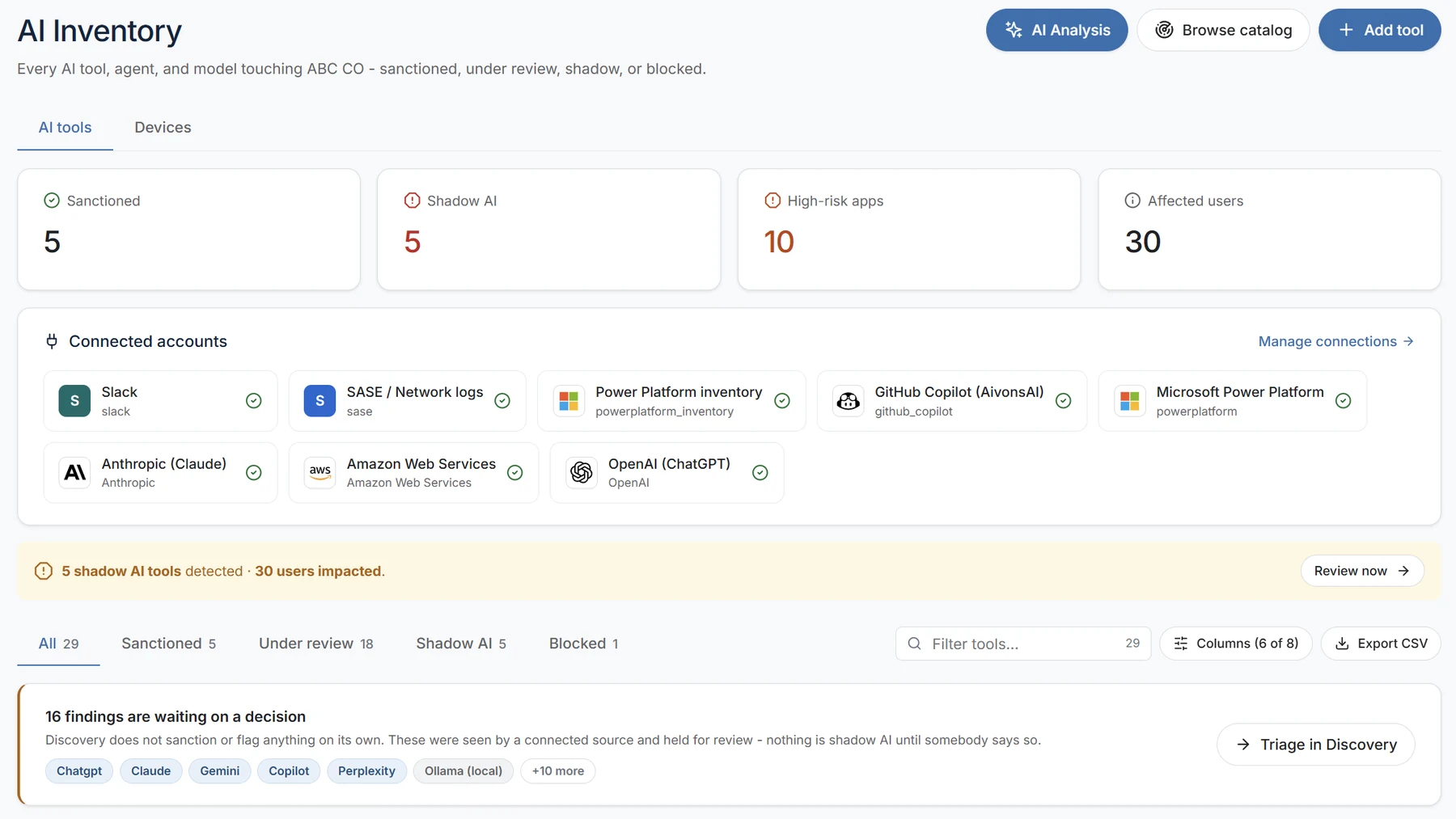
Twenty-nine tools across eight connected sources, and sixteen of them held rather than labelled. The panel says why: discovery does not sanction or flag anything on its own - these were seen by a connected source and put in front of a person, because nothing is shadow AI until somebody says so. An inventory that auto-labels is making governance decisions no one asked it to make.
How it works
Four stages. The order matters more than the speed.
Read-only wherever the platform allows it. No rip-and-replace, no inline proxy for core discovery, no standing administrative write credentials. Roughly thirty minutes, scoped to APIs named up front and revocable at any time.
Signals come from the estate you already run: identity, SaaS, cloud, endpoint, browser, network, AI platforms, automation platforms and your security controls. Plus an optional PowerShell endpoint collector run from your RMM, which installs nothing.
A browser event on its own tells you very little. So does a service principal, or an application registration. Correlation is the work - joining those signals so you can see they belong to the same AI system, and counting a replica promoted through three environments as one agent rather than three.
Each system lands in a governance state: sanctioned, under review, shadow, unowned or not assessed. That last state is deliberate - a surface nobody connected is not a surface with no risk.
See it on your own estate.Thirty minutes to connect, read-only, no proxy, and a first inventory within hours.
Get my AI Exposure ScoreShadow AI is more than employees using ChatGPT
Most shadow AI programmes look for staff visiting public AI websites. That is the easy half, and blocking those domains can leave the larger problem untouched.
- Shadow AI use. People reaching unsanctioned services through browsers, desktop applications or extensions. Findable from browser, endpoint, network and security signals - and, on the endpoint, including native desktop applications that appear in no uninstall key and extensions installed in a second browser you never replaced.
- Shadow AI agents. The more consequential category: agents and automated workflows created inside platforms you already approved. They can run with no active user session, authenticate with their own machine identity, connect to enterprise applications, reach organisational data, execute on a schedule, and keep running long after their creator stopped using them.
- The consequence. An organisation can block every public AI website and still be running hundreds of unmanaged AI systems internally, built by people who never needed a security review to publish one.
Know what you know — and what you do not
A governance product that produces false confidence is worse than none, because it moves risk from visible to invisible. Where a platform is not connected or a dimension cannot be measured, Govern360 reports not measured rather than assuming there is nothing there — so you can always tell the difference between measured and safe and simply not measured.
Discovery is the largest single weight in the AI Exposure Score, because every other dimension depends on a complete inventory. An agent nobody found cannot be governed, protected, controlled or proved. The dimension measures coverage - how much of the estate is connected and measured - alongside ownership rate, shadow AI share, identity exposure, access exposure and governance gaps. Every gap is a finding with a point value and a named fix.
 Open full size
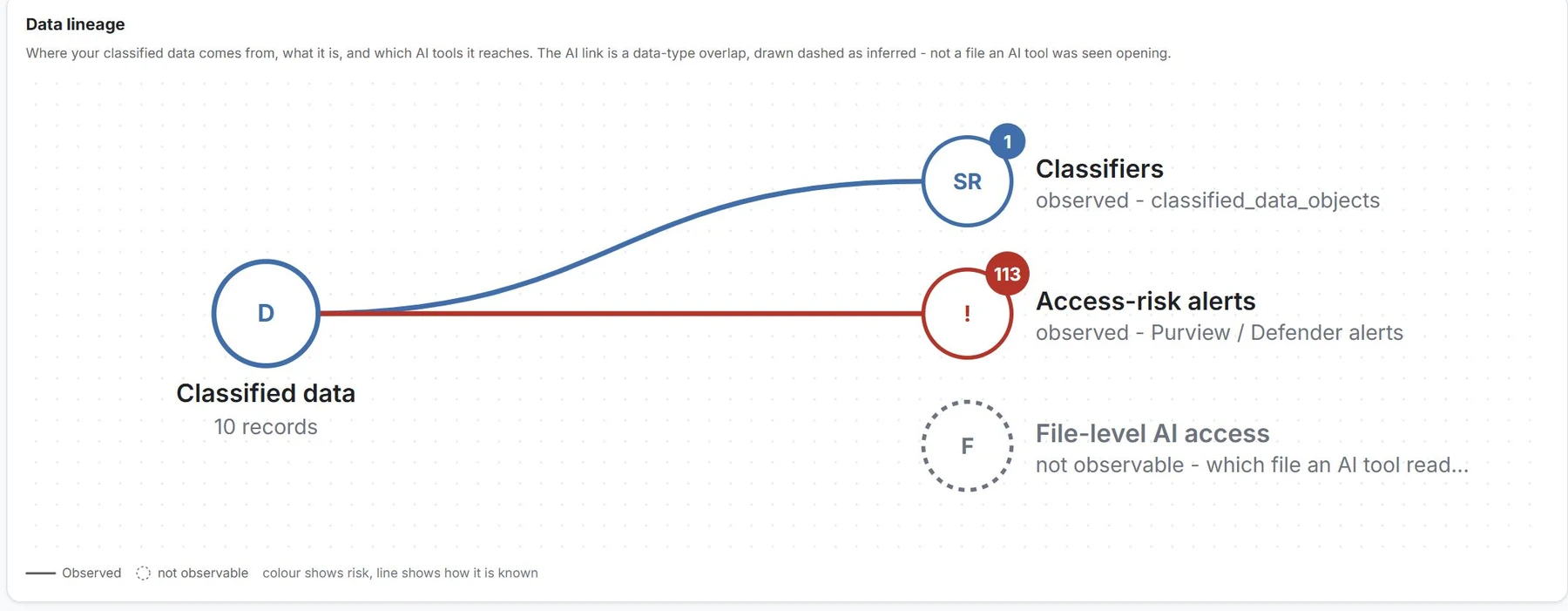
Classified data on the left; what is actually known about it on the right. Two links are solid because they were observed - the classifier result, and the Purview and Defender alerts. The third node is dashed and labelled not observable: which specific file an AI tool opened is beyond what these sources can show. Most products would leave that node out entirely, and the picture would look more complete than the evidence is.
Where this sits in the platform
Five stages, in order. Each depends on the one before it, which is why an unconnected source weakens everything downstream rather than only its own dimension.
What this page does not claim. Discovery reads configuration and management APIs. It can tell you a system exists, what it is scoped to reach and who created it - it does not observe what that system did at run time. Coverage reflects the sources you connect; an unconnected layer reads not assessed rather than clean. Figures cited here come from a connected demonstration tenant, not a customer estate.
Questions, answered
How fast is discovery?
Connection takes minutes per supported source, and a first inventory typically appears within hours. Coverage improves as more sources are connected - which is why the coverage fraction is published beside the number rather than hidden.
Does discovery require installing agents?
Not for core platform discovery, which runs entirely on APIs and telemetry you already have. The optional endpoint collector is a PowerShell script run from your RMM that installs nothing and needs no admin rights; the managed browser extension is separate again, optional, and not required for a score.
Does Govern360 sit in the traffic path?
No proxy is required for discovery. Govern360 observes and correlates rather than intercepting, so it never becomes a hop in your network, a latency budget or a single point of failure.
Can it find shadow AI?
Yes, across both kinds - unsanctioned tools people use, and unmanaged agents built inside platforms you already approved. The second kind is usually larger and is invisible to domain blocking.
Can it discover autonomous agents?
That is the core of it. Agents are inventoried and correlated with their model, connectors, identities, permissions, owner and activity - including agents that hold no machine identity and therefore run as the person who created them.
What happens when something cannot be assessed?
It is reported as not assessed rather than treated as safe, and excluded from the score rather than counted as zero. Incomplete telemetry producing an artificially good number is the failure mode this exists to prevent.
Do we have to replace our existing security tools?
No. Discovery adds an AI-centric layer across the identity, endpoint, network, SaaS, cloud and data-security tools you already operate. Their signals become one AI view instead of staying isolated in a dozen consoles.
Is discovery only useful to security teams?
No. The same inventory answers different questions for the CISO, CIO, CAIO, risk, compliance, application owners and the board - which is why the register carries owner, purpose and cost alongside the security attributes.
Go deeper
The detail behind this page, in the form it is usually asked for.
Across agents, OAuth grants, email, browsers and network. Read-only, with first findings inside 24 hours.
AssessmentAI Sprawl AssessmentFind every AI tool, agent, Copilot and shadow account, with the owner and the risk behind each one.
BenchmarkAI Agent Sprawl BenchmarkWhat full-estate assessments actually return, and how those numbers break down.
SampleBoard-ready Exposure ScoreReal output from a Govern360 tenant: one 0-100 number, every point traceable to a finding.
You cannot govern AI you cannot see.
Connect Govern360 and see how much of your AI estate is known, owned and governed - and how much is operating outside your current visibility. Thirty minutes, read-only, no proxy, first findings within hours.