AI governance was built for a world that no longer exists.
Spreadsheets, static policies, and once-a-year audits cannot keep pace with AI that spreads, spends, and acts on its own. Govern360 replaces point-in-time governance with a continuous control plane — and one explainable score.
Traditional AI governance vs. Govern360
The same responsibilities, handled two completely different ways.
AI inventory
× Traditional: Manual, point-in-time spreadsheets
✓ Govern360: Continuous, automated AI discovery
Policy
× Traditional: Static documents nobody enforces
✓ Govern360: Live policy compiled into Purview & Intune
Audit & evidence
× Traditional: One-time scrambles before a review
✓ Govern360: Continuous, audit-ready evidence
AI spend
× Traditional: Unknown, unattributed on the cloud bill
✓ Govern360: Every token attributed, explainable allocation
Agents & identities
× Traditional: Ungoverned, no owner, never offboarded
✓ Govern360: First-class identities, least privilege, tamper-evident trail
Data protection
× Traditional: Detection after the leak
✓ Govern360: DLP prevention at the point of use
Governance health
× Traditional: A subjective opinion
✓ Govern360: One explainable Govern360 AI Exposure Score™
The shift in one sentence
Governance stops being a document you produce and becomes a number you improve. Govern360 discovers AI continuously, enforces policy live, keeps evidence current, attributes every dollar, and rolls it all into the Govern360 AI Exposure Score™ — so safety becomes something teams raise over time, not a gate that slows them down.
Observed, without sitting in the path
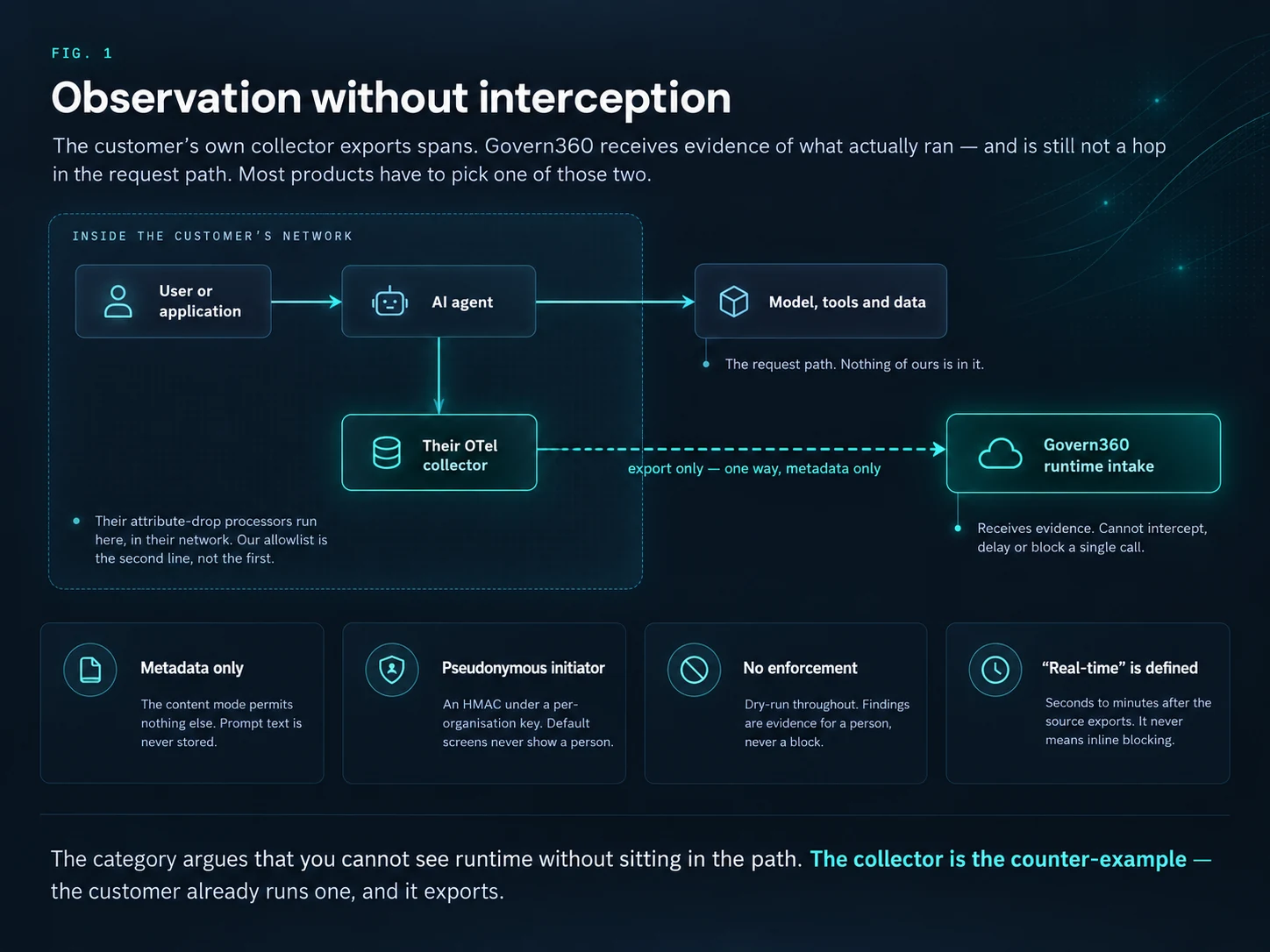
The category's standing argument is that you cannot see what an agent actually did unless you are in the request path. The customer's own collector is the counter-example.
 Open full size
Enterprises already run an OpenTelemetry collector. It exports spans, so Govern360 can read what an agent actually called without becoming a hop in front of it — no latency to budget for, no new single point of failure, and nothing to roll back under change control. Their attribute-drop processors run inside their network; our allowlist is the second line of defence, not the first. Four limits hold by design: metadata only (prompt text is never stored), a pseudonymous initiator (an HMAC under a per-organisation key, so default screens never name a person), no enforcement anywhere in this programme, and “real-time” defined as seconds to minutes after the source exports — it never means inline blocking.
A decision is not an invocation
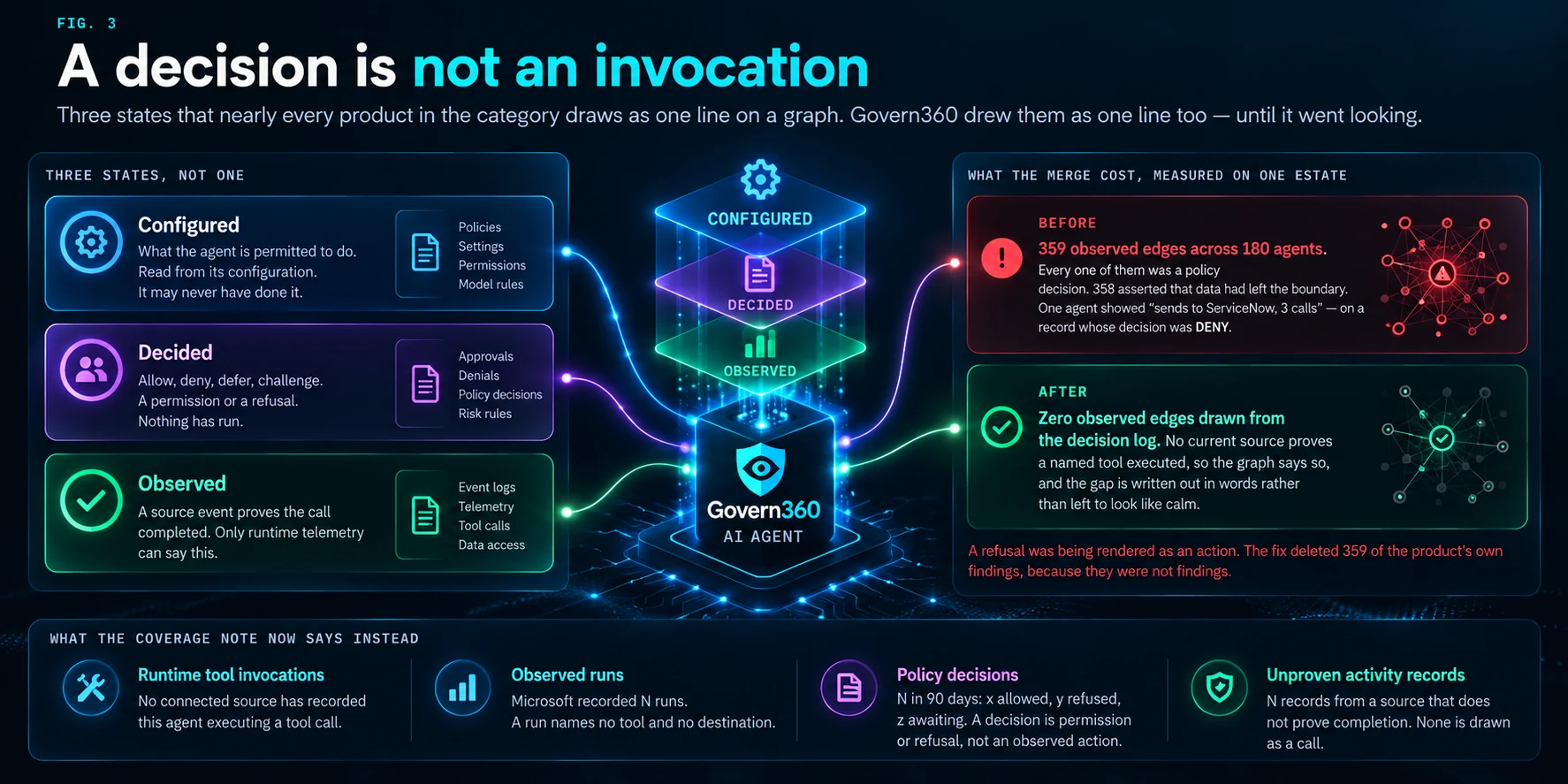
Three states that most products in this category draw as one line on a graph. Govern360 drew them as one line too, until it went looking.
 Open full size
Configured is what an agent is permitted to do. Decided is a permission or a refusal — nothing has run. Observed means a source event proves the call completed. On one connected estate this product was drawing 359 observed edges across 180 agents, and every one of them was a policy decision; 358 of them asserted that data had left the boundary. One agent showed “sends to ServiceNow, 3 calls” on a record whose decision was DENY — a refusal rendered as an action. The fix removed all 359, because they were not findings. What the coverage note says now is that no connected source has recorded that agent executing a tool call, which is a less impressive screen and a true one.
Questions, answered
How is Govern360 different from traditional AI governance?
Traditional AI governance is manual and point-in-time — spreadsheet inventories, static policies, and audits done once a year. Govern360 is continuous: automated discovery, live policy enforcement, ongoing evidence, attributed spend, and a single explainable AI Exposure Score that updates as your estate changes.
Is Govern360 a consulting service or a product?
A product. It is the enterprise AI control plane — software your team operates continuously — not a point-in-time assessment delivered as a slide deck.
What makes the AI Exposure Score better than a dashboard?
A dashboard reports numbers; the score turns them into a prioritized worklist. Every point traces to a finding with a fix and a point value, so the score drives action instead of just describing status.